

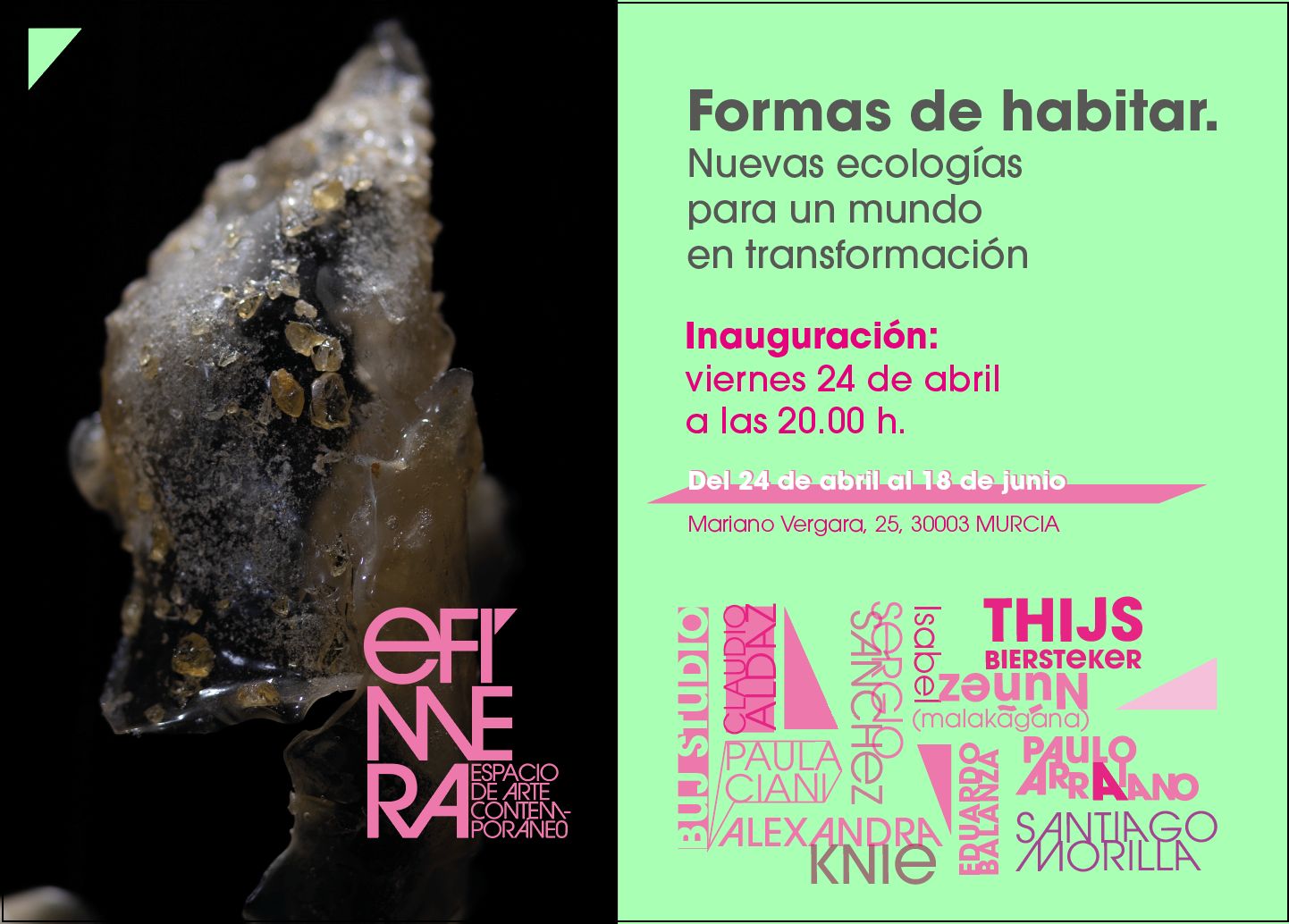
Forms of Living. New Ecologies for a World in Transformation
Belén Vera
Forms of Living. New Ecologies for a World in Transformation is grounded in an increasingly evident certainty: ecology has ceased to be a topic and has become the framework through which we think and inhabit the present. It no longer exists outside us, as landscape or backdrop, but instead runs through bodies, technologies and material systems. As Timothy Morton suggests, we inhabit a network of relations in which the idea of an “outside” loses its meaning. Far from any idealised image of nature, this perspective situates us within an unstable terrain, where the ecological crisis is no longer distant but experienced as a shared condition.
From this point, the exhibition unfolds as a journey across different scales and forms of relating to the environment. There is no single narrative, but rather a set of approaches that, when brought together, construct a complex image of the present.
The work of Thijs Biersteker operates at an almost imperceptible level. Through data visualisation, his pieces transform polar ice melt into a sensory experience. What emerges is not a representation of the landscape, but the activation of an ongoing process that exceeds the visible and affects entire systems.
This dimension intersects with the historical and political perspective present in the work of Paulo Arraiano, where extractivism appears as a persistent structure linking past and present. His works reveal how colonial dynamics continue to operate in contemporary forms of production and circulation, turning the territory into a space marked by tensions and memory.
The exhibition then opens onto practices that engage with the living from an expanded perspective. Buj Studio, Alexandra Knie, Santiago Morilla, Paula Ciani, Eduardo Balanza and Isabel Núñez explore organic materials, biological processes and interspecies relations that blur the boundaries between nature and technology. Their works position life as a system in constant transformation. At this point, the ideas of Donna Haraway also resonate, inviting us to think of the world as a web of coexistences.
In its final section, the exhibition addresses one of the most tangible aspects of contemporaneity: technological waste. Claudio Aldaz and Sergio Sánchez work with discarded materials and obsolete devices, making visible the continuity between production, consumption and disposal. Waste thus appears as an active component within the same system.
Rather than functioning as isolated blocks, these lines intertwine throughout the exhibition. Ice melt, extractivism, interspecies ecologies and technological waste are presented as manifestations of a single network. The exhibition thus takes shape as an ecosystem where research, artistic practice and critical reflection coexist.
Forms of Living. New Ecologies for a World in Transformation does not seek to offer solutions or close a narrative, but to sharpen perception and open a space for pausing and observing the connections that shape our present. Here, to inhabit means recognising the complexity of the systems in which we are embedded and, through art, experimenting with other ways of relating to what surrounds us—and ultimately, what also constitutes us.