

Interview with BUJ Studio
The Body as a Material Interface
By Belén Vera
Raquel Buj’s practice, at the helm of BUJ Studio, operates within a hybrid territory where architecture, fashion and material experimentation intersect. Her work moves across disciplines —design, sculpture, performance— while maintaining a consistent focus: to think of the body as a space of relation with its environment. Her pieces do not simply dress the body; they extend it, amplify it, and place it in dialogue with material, technological and biological systems.
Trained as an architect, her shift towards experimental design was not a rupture but a way of recovering a direct relationship with matter. “When I was working in architecture, I felt that connection fading. You draw, you project, but in the end others build it. I needed to return to a more physical, intuitive process,” she explains. This shift led her to explore the body as an intermediate scale, a site from which to rethink architecture through proximity, sensitivity and tactility.
At BUJ Studio, material becomes the starting point. In contrast to more conventional processes, where the idea precedes form, her practice unfolds through direct experimentation: testing, failure, transformation. “Material tests themselves lead us to decisions that are not only formal, but also conceptual,” she notes. This approach keeps the process open, allowing the work to evolve without being fully defined from the outset.
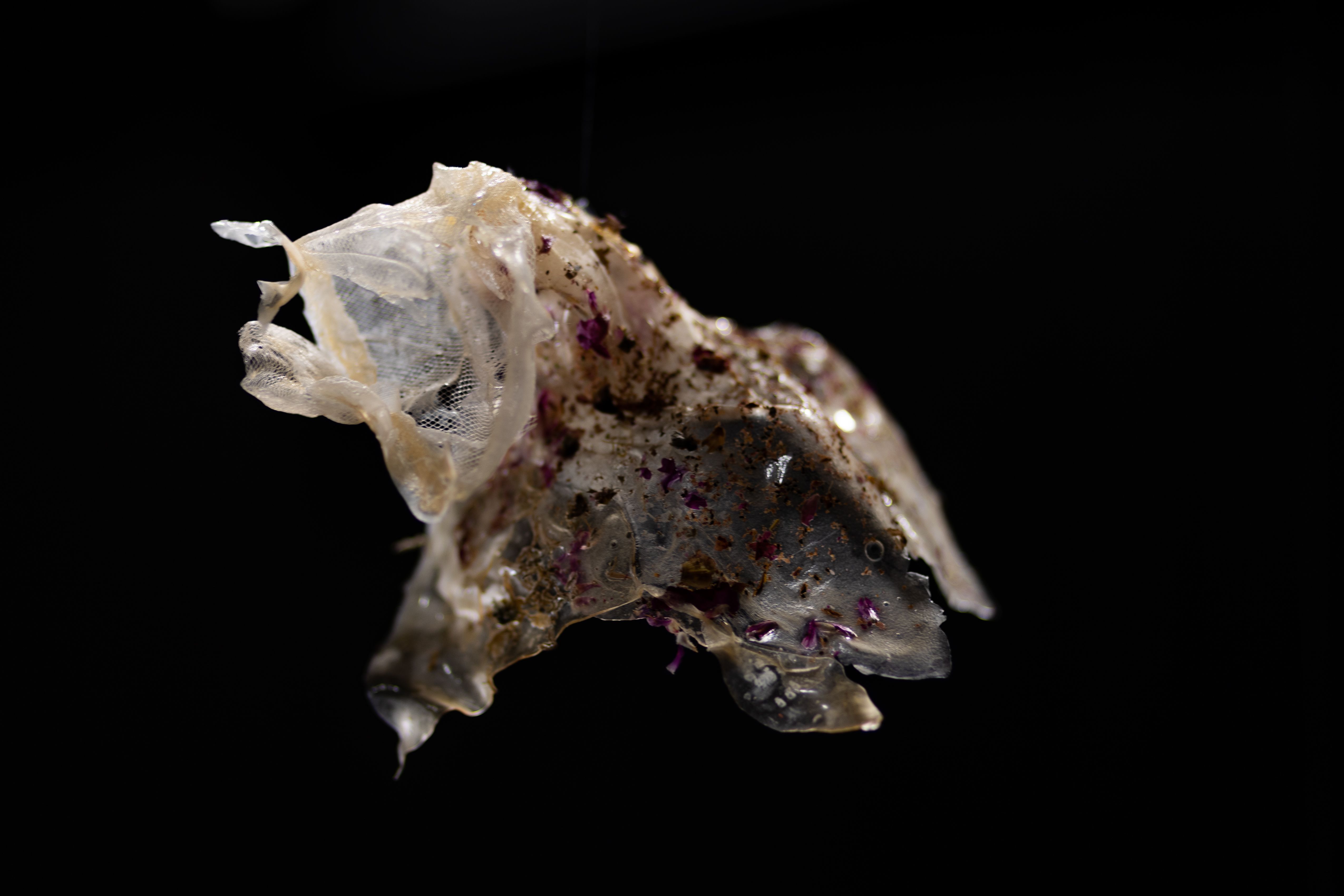
Her research focuses particularly on biomaterials, recycled textiles and compounds developed within the studio. This choice goes beyond the technical and reflects a position in relation to an accelerated system of production detached from material awareness. “We live in a world with very little connection to materials,” she states, pointing towards the need to rebuild that relationship through attention, time and sensitivity.
The resulting pieces occupy an ambiguous territory between garment, sculpture and installation. Structures that envelop the body, expand it or transform it, operating as active surfaces in constant dialogue with their surroundings. Within them, craft and technology do not oppose one another but intertwine: manual techniques, 3D printing and biological processes coexist within the same experimental logic, generating unstable, evolving materialities.
Collaboration is a structural part of her practice. From projects with engineers and technologists to collaborations with artists, musicians and performers, Buj approaches design as an open field where disciplinary boundaries dissolve. In one recent project, she integrated motion sensors into a garment, turning it into a reactive surface capable of generating light, sound and interaction.
More than responding to sustainability as a label, her work proposes a different relationship with processes of production. Many of her pieces are unique, already challenging the logic of repetition and seriality. At the same time, her material research involves reusing previous tests, reintegrating discarded elements and working with biomaterials developed within the studio. “It’s not just about recycling, but about not discarding — about continuing to work with what already exists,” she explains.
Her practice continues to expand into new territories. Recent projects explore living materials such as mycelium, as well as the integration of sculpture, scenography, sound and the body within hybrid proposals situated between installation and performance. This openness reflects a way of working closer to research than to closed production.
In this context, the body ceases to be a boundary and becomes an interface — a space of exchange where matter, technology and life converge. Her practice unfolds in that intermediate zone where the material, the living and the artificial intertwine, opening up new ways of imagining our relationship with the environment.